
The week-long 20th national congress of the Communist party of China began in Beijing on Sunday, October 16, 2022.
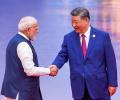
A senior Chinese Communist Party official stated that the meeting between Prime Minister Narendra Modi and President Xi Jinping was fruitful, leading to a new consensus on developing bilateral relations. Both countries aim to enhance cooperation and manage differences.
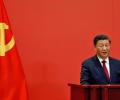
The Chinese Communist Party reaffirmed President Xi Jinping's leadership and backed a major purge of top military officials during a key meeting. The meeting also endorsed a new 5-year plan focused on domestic market resilience and self-reliance.

If Xi Jinping can establish control over the PLA Ground Force, relations between India and China will settle down to an even keel. The next few weeks will show whether Xi has finally succeeded in gaining control over the PLA Ground Force. That could bring about the substantive shift in India-China relations that both our leaders have been working for, observes Ambassador Prabhat Shukla.

Experts said the direction is meant to maintain party unity.

One person was killed and eight others injured when a series of home-made bombs packed with ball bearings exploded in front of a provincial office of the ruling Chinese Communist Party, two days ahead of the party's key meeting to finalise political and economic reforms.

Dr Jaishankar, right, appears to look away from Wang Yi, second from right, at the East Asia Summit Foreign Ministers Meeting in Jakarta, Indonesia, Friday, July 14, 2023.

Except for Xi, 69, all top officials including the number two leader, Premier Li Keqiang will be replaced in the massive reshuffle to follow in the days to come, which included a new foreign minister replacing the incumbent Wang Yi.
China's second-ranked general, He Weidong, is under investigation for corruption, along with nine other senior military officers punished for discipline violations and work-related crimes. This crackdown comes ahead of a key Communist Party conclave.
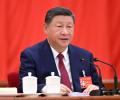
If Xi Jinping is dethroned in the future, the instrument for that may well be embedded within the PLA, notes former foreign secretary Shyam Saran.
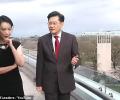
China's Foreign Minister Qin Gang has not been seen in public since June 25. Is he unwell, or has he been purged?
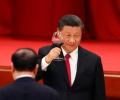
President Xi Jinping, who has been occupying the top post since 2012, was unanimously chosen as a delegate to the ruling party's 20th national congress at the CPC Guangxi regional meeting on April 22.

On the fourth day of their brain storming Congress to select new set of Chinese leaders to replace the current lot, ruling Communist Party on Sunday finalised a list of candidates for the 365-member Central Committee, an administrative and policy body, that would govern the country for next 10 years.
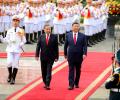
'A small boat with a single sail cannot withstand the stormy waves, and only by working together can we sail steadily and far,' Xi told the Vietnamese leadership.

Vice Admiral Li Hanjun, chief of staff of the People's Liberation Army Navy (PLAN), and Liu Shipeng, deputy chief engineer of China National Nuclear Corporation, have been expelled from the National People's Congress (NPC), the Hong Kong-based South China Morning Post reported.
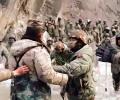
China has honored an army regiment commander who was injured in the Galwan Valley border clash with Indian soldiers in 2020 as an outstanding member of the national advisory body - Chinese People's Political Consultative Conference (CPPCC). Qi Fabao, who was made the torchbearer for the Winter Olympics in 2022, was among the 33 individuals honored with the 2024 Outstanding Performance Award for CPPCC Members. The incident, which resulted in the deaths of 20 Indian soldiers, led to a freeze in relations between the two countries for over four years. Ties were restored after a meeting between Prime Minister Narendra Modi and President Xi Jinping in October 2023.
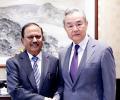
Wang is travelling to India days ahead of Prime Minister Narendra Modi's planned trip to the Chinese city of Tianjin to attend the annual summit of the Shanghai Cooperation Organisation.

Statements emanating from the recent Chinese Communist party congress suggest potentially increasing pressure on India with regard to the Dalai Lama and the Central Tibetan Administration in Dharamsala, notes former RAW officer Jayadeva Ranade.

The Chinese Communist party has not closed its door of contacts and negotiation with the Dalai Lama, a senior Communist leader wrote recently. Former RA&W officer and China expert Jayadeva Ranade explains what the thinking on Tibet is likely in Beijing.

'By treating Nepali politicians as shabby buffoons to be pampered one day and collared another day, India badly exposed itself.' 'A belief got entrenched in the Nepalese mind that we are a dangerous neighbour,' observes Ambassador M K Bhadrakumar.
The announcement on expansion of CPEC was made following a meeting among Chinese Foreign Minister Wang Yi, his Pakistani counterpart Ishaq Dar and Afghanistan's Acting Foreign Minister Amir Khan Muttaqi in Beijing, according to a Pakistani readout.
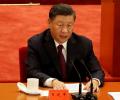
India, Taiwan and countries with large numbers of Tibetans, Uyghurs and overseas Chinese will be prominent among those that witness elevated United Front activity, notes Jayadeva Ranade, the distinguished China expert and retired RAW officer.
Rebuffing the Dalai Lama's remarks that there were "encouraging signs" about China changing its attitude towards Tibet, a top Chinese official has said there would be no breakthrough in talks until the Tibetan spiritual leader changed his stand on "some fundamental issues".

The Chinese Communist party's central committee on Thursday, November 11, adopted a landmark resolution on the party's 'major achievements and historic experiences', effectively consolidating CCP General Secretary Xi Jinping's lifelong hold on power.
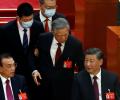
Hu, 79, sitting next to President Xi Jinping in the front row with other top leaders at the ornate Great Hall of People was persuaded to leave the meeting by two men, presumably security guards.
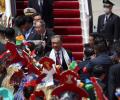
Wang Yang and Xi Jinping's visits signal the beginning of a major Chinese push to bring about a transformation of Tibet, observes Jayadeva Ranade, the distinguished China expert and retired RA&W officer.

The Central Committee members on Sunday elected a 25-member Political Bureau which picked the Standing Committee members to govern the country.
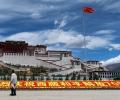
National security, consolidation of border defences and border security highlights China's Tibet policy, points out Jayadeva Ranade, the former senior RA&W officer and China expert.

The Chinese Communist Party's all important 19th Party Congress is just months away, and President Xi Jinping finds himself confronting unlikely challenges to his pre-eminent position, says former RA&W officer and China watcher Jayadeva Ranade.

'The title of 'core' of the leadership gives Xi Jinping greater political authority at a time when China is beset by various problems as well as a slowdown in economic growth,' points out former RA&W officer Jayadeva Ranade.
The Communist Party of China has clipped the wings of Bo Xilai, a popular leader among netizens. B Raman explains why
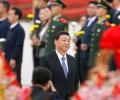
Wang Junzheng, Tibet's new Communist party boss, is on a number of sanctions lists by the US, Britain, the EU and Canada, for his tough role in Xinjiang, aimed at China's Uyghur ethnic minority, observes Jayadeva Ranade, the retired senior RA&W officer and distinguished China expert.
A delegation of the Communist Party of China left Beijing for a visit to India, the official Xinhua news agency said in a brief report. The delegation is headed by Liu Qibao, member of the CPC's powerful Central Committee.
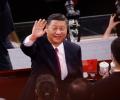
There is simmering disquiet in the Communist party and the world is watching as to what can unfold in China in the days to come ahead of next year's party congress, notes Rup Narayan Das.
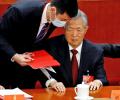
In scenes replicating purges at party conferences in Pyongyang, Xi Jinping appeared to borrow from Kim Jong Un's playbook when he had Hu Jintao, his predecessor as Communist party general secretary and president of the People's Republic of China, evicted from the final session of the 20th party congress on Saturday, October 22, 2022 in full view.

A visit to Tibet appears to have become the new touchstone for expressing fealty to Xi Jinping, observes Jayadeva Ranade, the retired senior RA&W officer and distinguished China expert.

Chinese President Xi Jinping is all set for an unprecedented third five-year term as he was 'elected' to the powerful Central Committee of the ruling Communist Party on Saturday while several top leaders including Premier Li Keqiang have been left out in the major shake-up at the top.
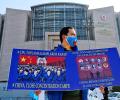
A top leader of the ruling Communist Party has asked China's over 25 million Muslims to "uphold the banner of patriotism" and reorient Islam to adapt to Chinese conditions, amid Beijing's diplomatic offensive to counter a damning UN report accusing it of serious human rights violations against Uygur Muslims.
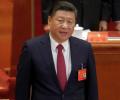
Xi's concept of "socialism with Chinese characteristics for a new era" was added to the party's Constitution

'Even though as Xi will seemingly continue to stay in power beyond his third term, competitions for the post-Xi leadership would be inevitably unfolded beneath the surface of water, and that will be a big headache for Xi the dictator.'
 © 2026 Rediff.com - Advertise with us - Disclaimer - Privacy Policy - Sitemap - Feedback - About us - Terms of use - Grievances